
Table of contents
- 1. Civil Service Management Board Talks Renewal
- 2. December 2016 – Robert Watt
- 3. December 2016 – John McCarthy
- 4. October 2016 – Maurice Quinn
- 5. April 2016 – Seán Ó Foghlú
- 6. March 2016 – Robert Watt
- 7. January 2016 – Robert Watt
- 8. December 2016 – Robert Watt
- 9. September 2015 – Mark Griffin
- 10. July 2015 – Niall Cody
- 11. June 2015 – Jim Breslin
- 12. May 2015 – Robert Watt
- 13. May 2015 – Dr Orlaigh Quinn
- 14. April 2015 – Dr Orlaigh Quinn
Below, members of the Civil Service Management Board have provided their insights to the Renewal Plan – from why the Plan was needed, to discussing the results of the first Civil Service Employee Engagement Survey, to the impact of Civil Service Renewal on Irish society.
Dear all,
As we approach the end of 2016 I am delighted to say that we have surpassed the half-way point in implementing our ambitious Civil Service Renewal Plan. All 25 headline actions in the Civil Service Renewal Plan have been initiated with several actions completed.
I am proud of the work that we are leading on Renewal as we strive towards delivering a world-class service to the State and the people of Ireland. I would like to thank you all for your continued participation, contribution and support in successfully progressing the implementation of the Renewal Plan. At this stage we should all be seeing the positive impact of the Renewal Plan in our Departments/Offices.
We are fostering a culture of innovation in the Civil Service and the 2nd Annual Civil Service Excellence and Innovations Awards, held in the Royal Hospital Kilmainham in December, showcased best practice across the Civil Service. In showcasing our work we can help to rebuild pride and confidence in the Civil Service – both for civil servants and our citizens. Highlighting the work we do gives the people we serve a better understanding of the role of the Civil Service and I am proud of the tremendous range of complex quality work carried out by civil servants to support the Government and deliver public services.
This year we adopted a thematic approach with the Town hall meetings focusing on specific actions such as performance management, staff mobility, learning and development and talent management. These meetings proved to be a great success in keeping you informed of developments, hearing your views and giving you an opportunity to input into the implementation process. We will continue to hold the Town Hall meetings in 2017 and will publish a schedule of events early next year. We are also developing a comprehensive communication and engagement strategy which will target both internal and external stakeholders. I will keep you updated on progress throughout next year.
You are welcome to email the Civil Service Management Board to share your views through csrenewal@per.gov.ie.
I hope each and every one of you has a good break over Christmas and look forward to working together to continue to make strides in renewing the Civil Service in the New Year.
Kind Regards,
Robert Watt, Secretary General,
Department of Public Expenditure and Reform.
Action 9 in the Renewal Plan, co-sponsored by myself and Niall Cody, sets out the vision for a new shared model for delivering learning and development and aspires to position the Civil Service as a market leader in the provision of effective learning and development supports for employees. It is very probably the one Renewal action that will impact on each of us and aims to encourage all of us to learn and develop a range of professional skills and competencies throughout our careers to support the highest levels of individual and organisational performance.
The new model will be supported by a digital platform accessible from our desktops and will provide all of us with an opportunity to engage with new and responsive training interventions, assess our skills, participate in e-learning initiatives and, over time, embrace a suite of self-development opportunities and accreditation options.
A Project Team was established last year harnessing the learning and development expertise and experience of individuals across a number of Departments. Additionally, each Department appointed a Business Partner, the local learning and development experts and champions, who have been working very positively and collaboratively with the project team on the development of the new model. A new Head of Learning and Development for the Civil Service has been appointed and significant progress has been made on a number of other key elements of the new model.
These include:
- for the first time, a new suite of focused and responsive Civil Service face-to-face training programmes has been designed and will be available from early Q2 next year
- the new skills and qualifications register is near completion, another first for the Civil Service
- technology solutions have been appraised and a tender to procure the technology platform is currently being prepared
- preparations for the launch of an extensive communications plan in early 2017 are well underway
A Town Hall event dedicated to learning and development took place in July in the Conference Centre in Dublin Castle. There was a huge attendance and great interest and enthusiasm displayed on the day as the various key elements of the new model were outlined. It was also very encouraging to note that there was nearly unanimous agreement among those attending on the direction the new learning and development model will take.
The aim of this Renewal Action is to provide a world class learning and development offering that can be benchmarked with the best across Europe. It has the potential to transform the manner in which we deliver and engage with learning and development throughout our careers resulting in a much more informed, engaged, confident and motivated workforce. Myself and Niall look forward to engaging with you on this exciting and challenging project which will be implemented across the Civil Service in 2017 with a significant “win” for all of us.
Please email any comments or suggestions that you have on the implementation of this project to csrenewal@per.gov.ie
John McCarthy
Secretary General at the Department of Housing, Planning, Community & Local Government
The Civil Service Renewal Plan sets out a vision for strengthening capability across the civil service so that we can meet the needs and expectations of the Government and the public into the future.
The Plan sets out a series of initiatives aimed at enhancing capability. One such initiative is set out under Action 20 which provides for the Implementation of a programme of Organisational Capability Reviews. The purpose of the Reviews is to:
To embed a culture of regular and objective assessments of the capacity and capability of each Department to achieve its objectives and take the necessary action to close any gaps.
A sub group of the Civil Service Management Board (CSMB) was set up to implement Action 20 made up of Seán Ó Foghlú, SG, Department of Education and Skills, Mark Griffin, SG, Department of Communications, Climate Action and Environment, and myself. Our task is to design and implement a light touch, objective review process to assess how well a Department is equipped to develop and deliver on its remit. The focus is on the capability of departments to develop policy and strategy that delivers on today’s objectives and anticipates future challenges.
Having carried out comparative analysis of capability models and consulted with experts in the area, the CSMB agreed on a model that is now being tested by our colleagues in the Department of Transport, Tourism and Sport (D/TT&S). This work is being led by the Capability Review Team (the Team) comprising Dave Hanley, PO, Gerry Cribbin, AP and Brendan Ring, HEO, and a Lead Liaison Official in D/TT&S, Martin Diskin, PO.
Pilot Capability Review
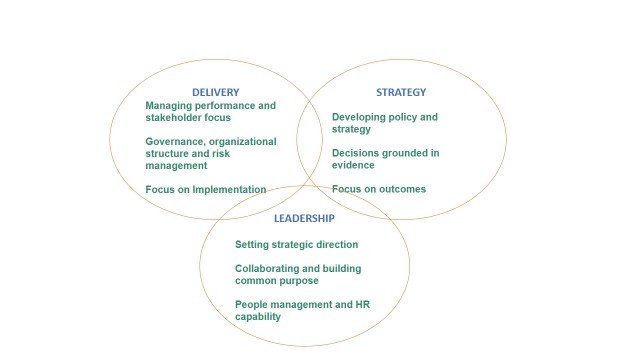
The pilot review underway in D/TT&S is guided by a detailed standards-based methodology template. In practice, this means that the Department’s capability is being tested against a series of best practice statements. That process involves primarily gathering views in interviews and staff workshops on a secure and confidential basis by reference to nine attributes under the three themes of Delivery, Strategy and Leadership as follows:
The staff workshops are organised on a grade basis up to and including Assistant Principal. A significant number of workshops have already taken place or are in the pipeline for staff across the Department’s offices in Dublin, Killarney, Shannon and Loughrea. One-on-one interviews have also been held or arranged with individual members of the Department’s management board and wide cross-section of Principal Officers. The Team is also engaging with a representative selection of the Department’s external stakeholders. Account is also being taken of a wide range of public and internal documentation.
Very open engagement
We were heartened by the Team’s reports on the level and openness of all engagements so far. Participants in the interviews and workshops have contributed in forthright and thoughtful ways. That augurs well for a comprehensive and rounded suite of findings, supported by evidence, on the Department’s capabilities to meet its business objectives and needs.
Governance of the review
The Civil Service Renewal Plan recognised the value in engaging with external peers as part of the capability review. We are fortunate to have an experienced and committed External Peer Review Panel for the pilot review. Their role is to validate, edit and finalise the report prepared by the Team. The Panel comprises:
- Catherine Treacy, Former Chief Executive, Property Registration Authority
- Tom Moran, Former Secretary General, Department of Agriculture and the Marine
- Professor Joe McDonagh, Head of Business School, Trinity College
Preparing an Action Plan
Obviously, any Capability Review should be supported by an Implementation Plan. The approach envisages the Team developing a standardised Action Plan Template whereby, for each finding, there will be a specific follow-up action(s) that will be time-bound and have a Senior Responsible Owner. On conclusion of the pilot review, the Management Board of the D/TT&S will embark on preparing the follow-up action plan. The main responsibilities of the Management Board will be:
- Overseeing preparation of the Action Plan and inputting into its development in collaboration with the Department’s Lead Liaison Official
- Satisfying itself that the Plan dovetails with the standardised Template
- Ensuring that the follow-up actions are both challenging and realistic, and
- Engaging with the Secretaries General of the Department of the Taoiseach and the Department of Public Expenditure and Reform on the Action Plan.
Regarding follow-up, the Accountability Board chaired by the Taoiseach will review implementation of the recommendations arising from all the reviews.
Next steps and project timeline for pilot review
The plan is to have the pilot review completed by the end of the year. Towards conclusion of the pilot review, a further Department will be selected as part of a rolling programme of organisational reviews across the Civil Service. Lessons learned will be factored into the approach for those reviews.
Conclusion
The Capability Review Programme has got off to a very promising start. Everyone involved has been open and constructive. There has been a strong and evident focus on developing the future capacity of the Department of Transport, Tourism and Sport. Obviously, it will be the nature of follow-up that fundamentally matters. I believe that for all of the reviews, the necessary checks and balances are in place to ensure that findings, informed by those in the organisation, will be acted upon and in a manner that will enhance overall capability, at the levels of both individual Departments and the wider Civil Service.
Please email any comments or suggestions that you have on the above to csrenewal@per.gov.ie
Maurice Quinn
Secretary General at the Department of Defence
The Civil Service Renewal Plan identifies that we need to build upon what we do well as a Civil Service and identify what we can do better. The Plan highlighted that we can operate in an overly rigid way based on the separate roles of Government Departments rather than taking a whole-of-Government approach. There is a need to harness better the various contributions from within the Civil Service that better supports the implementation of Government priorities with a view to a common end.
These arrangements can comprehend all aspects from the development of policy and its approval at political level through to its delivery by one or a number of Departments or public service bodies. Accordingly, Action 5 of the Plan identifies a need to improve the delivery of whole-of-Government projects.
Three pathfinder projects have been identified to test new approaches to implementing such whole-of-Government projects. These are:
- The Public Services Card which has been developed to establish and authenticate an individual’s identity for the purposes of access to public services
- The National Cyber Security Strategy which focuses on the security of the country’s computer networks and associated infrastructure
- The National Suicide Prevention Strategy which seeks to reduce suicide
We are seeking to develop an innovative working model for cross-government projects. The aim is that the working model will address practical issues of ownership, accountability and resource allocation in advancing the pathfinder projects and thus can inform the approach for future projects.
In examining these practical issues we have identified a number of common challenges:
- Ensuring a shared vision and objectives among those involved
- Enhancing collective ownership and individual accountability for delivery
- Assigning delegated authority to a designated lead role across multiple Departments
- Ensuring relevant programme funding is subject to this delegated authority and linked to delivery of actions and outcomes
We consider that having a shared vision and objectives for any cross-cutting projects is a vital ingredient of the change process being advanced. Developing a shared vision entails recognising linkages between the overall approach in the project and the goals of the individual participating Departments. In practical terms, this would mean that everyone involved will need to fully buy-in to the project being undertaken and work together on implementing the project. We are informed in exploring these issues by international research .
The practical arrangements for enhancing collective ownership and individual accountability for delivery are being explored. We are examining the establishment of new governance arrangements that are simple and unambiguous to ensure everyone working on the project understands what needs to be done and by whom.
We are also exploring the possible use of Section 12 of the Public Services Management Act 1997 to assign formal delegated authority and accountability to a civil servant who will lead a project and assign work on the project to staff across a number of Departments or other public bodies. It is striking that this provision has not been used to date; our examination may lead to Section 12 being tested in a practical way for the first time. We are also looking at how resourcing and reporting might build upon these arrangments.
The Accountability Board, chaired by an Taoiseach, also has an oversight role on the implementation of Action 5 and will review progress on this action.
Please email any comments or suggestions that you have on the implementation of this project to csrenewal@per.gov.ie
Seán Ó Foghlú
Secretary General at the Department of Education and Skills
Colleagues,
As you are aware, we are committed to keeping you updated on the progress we are making on the Civil Service Renewal Plan so that we can all work in a more professional, open and unified Civil Service. Some of the highlights of our progress in 2016 include:
- The Departmental results for the Civil Service Engagement Survey are being finalised and will issue to you shortly. These results are important because they will allow your leaders to understand the challenges specific to your workplace. Did you read the overall Civil Service results which we published in 2015? The results reflected what we learned during our engagement to prepare the Civil Service Renewal Plan.
This means that we already have a number of solutions underway to help in the challenging areas highlighted by you through the survey. Over the course of the next phases of the Civil Service Renewal Plan you will begin to see these improvements first-hand. - The Civil Service Management Board (CSMB) has already met twice this year – 29th January and 26th February. The Board discussed important staff issues like, PMDS, Staff Mobility, Talent Management, Learning and Development, Whole of Government projects, ICT: Build to Share, Improving Project Management Capacity. Take a look at the minutes on the Civil Service Renewal Portal and see what the CSMB are doing to progress these issues.
- We held a Town Hall on the 5th of February in Dundalk hosted by Niall Cody, Chairman of the Revenue Commissioners and Niamh O’Donoghue, Secretary General, Department of Social Protection. Over 170 staff from the North East attended and shared their views on how the CSMB can make the implementation of the Civil Service Renewal Plan meaningful for them and how they can contribute.
We had staff from the Revenue, Social Protection, Garda civilians, Department of the Environment, Community and Local Government and the Department of Children and Youth Affairs. Maybe you were one of these attendees? Tell us what we did well and what we can improve on csrenewal@per.gov.ie - The new 2-point PMDS rating format has now been introduced. You should have received communications from your own Personnel Unit informing you of these changes. David Cagney, Chief Human Resources Officer for the Civil Service, has given an undertaking to work closely with each HR Unit in each Department to create a PMDS system that develops our staff and that works –works for managers, works for staff and works for the public we serve – ensuring we are all accountable for what we do.
- We also worked to agree guiding principles for Staff Mobility. As a result a framework for internal mobility policies is being finalised and work has commenced on developing a policy for Interdepartmental Mobility across the Civil Service. I look forward to keeping you updated on this exciting change to the Civil Service.
- The Learning and Development project is making significant progress – at the moment the team are working to develop a new curriculum for us all as part of a unified Civil Service. We will hold a Town Hall meeting specifically on the new platform over the summer. However, given the scale of this project it will take time before any courses are rolled out under the new plan.
Focus groups to review the new curriculum are planned and volunteers to participate will be sought in the near future.
Robert Watt, Secretary General,
Department of Public Expenditure and Reform.
70% Engagement in the Civil Service Highlights Great Progress Implementing the Renewal Plan
The Renewal Plan aims to deliver real and tangible changes to staff that make a positive impact on their working lives, and to the public to make a positive impact on Irish society. Within one year, we have had great success implementing the Renewal Plan. 24 of the 25 actions in the Renewal Plan have been initiated and many are in full implementation including:
Of all of the projects we have initiated over the last 12 months, one of the most innovative and exciting is the launch of the first Civil Service-wide Employee Engagement Survey.
For the first time, we invited every single Irish civil servant working at home and abroad to share their views on working in the Civil Service so that we could understand what motivates and engages staff. A staggering number of staff responded to the survey – with 15,500 completed surveys returned to the Central Statistics Office for analysis. As you can imagine with those numbers, the analysis job was significant but credit to Padraig Dalton – Director General of the CSO – and his team. The CSO have done a fantastic job gathering the information and maintaining full confidentiality and anonymity for all of us throughout the process.
Today, the results – what you told us in the survey – will be published in full, online. They make for fascinating reading. The wealth of information we now have allows the CSMB to work even more effectively to collectively resolve system wide issues.
While we are often shy of talking about what we do well in the Civil Service, the results show that we shouldn’t be. Levels of engagement at work (75%) and resilience (69%) are incredibly high among staff. The vast majority of staff feel competent and skillful at work, confident in their skills and abilities (80%). The majority of staff (68%) feel the work they do is really important in serving the public and the State. The positive results should be showcased and celebrated.
The results highlight several challenges for us as an organisation. Staff views on leadership (50%), pay (42%), organisational support (44%), involvement in decision making (36%), and career development (44%) highlight important areas where we will need to work harder to make sure staff feel supported. Achieving this is important for the staff that we employ but also for all those who rely on the services that we provide. Improvement in these areas can only enhance our performance and effectiveness for the country.
A survey is just a survey. It’s what we do with the information that will make it count. The CSMB and I will redouble our efforts to implement the Civil Service Renewal Plan, focussing on the actions that the results highlight will be important: developing leaders, increasing mobility, ensuring a world class learning and development framework, communicating more about what we do and why.
We will also uphold our ongoing commitment to be transparent and to engage and listen to staff. The survey shines a spotlight on key issues: positive and negative. It’s our job now to understand what’s driving the results and why staff responded as they did so that we can build on what’s good and act, quickly and decisively to make improvements.
I am immensely proud of today’s Civil Service and of what we have and are contributing to the country. I welcome your feedback at any point in our journey to make the Civil Service a more Professional, Responsive, Open and Unified organisation that Delivers world-class services for the people of Ireland.
Email your ideas to make our goal successful to csrenewal@per.gov.ie.
Robert Watt
Secretary General at the Department of Public Expenditure & Reform
Civil Service Spokesperson
Civil Service Renewal – One Year On
Dear all,
As 2015 draws to a close, I am sending you the latest Civil Service Renewal Bulletin with all of the recent news about our progress implementing the actions in the Civil Service Renewal Plan. I invite you and your colleagues to take time to read it and reflect on all of the work we are leading to improve the Civil Service for all of us who work here and the public who rely on us to deliver the highest quality services.
In only 13 months we have achieved a huge amount – thanks to the hard work of thousands of civil servants around the country! I know that many of the Renewal Actions implemented to date may not resonate in our ordinary every day working life yet but they do lay the foundation for things to come –
- 15,000 of you responded to the First Annual Engagement Survey in September – the results will be published here in January
- 10 teams nationwide were awarded the First Annual Civil Service Excellence and Innovation Awards in December – you can see details of the winning teams, the 32 short-listed teams and the 96 nominated projects here
- Open competition have now been held at almost every grade.
- The new Civil Service Management Board has now met 11 times taking management decisions on the future of the Civil Service – all minutes are available here
- The new Accountability Board, chaired by the Taoiseach, has now met twice to discuss the framework for Secretary General performance reviews and organisational reviews – all minutes are available here
- 6 posts have been advertised under the new Principal Mobility scheme since it launched in September – 2 a month since the programme began.
Next year, there will be even more changes that affect your day-to-day as we prioritise improvements to performance management, mobility and learning and development. You can read about the 7 actions the Civil Service Management Board has committed to deliver for staff in the “next 200 days” by May 2016 here.
We will continue to hold the Town Hall meetings which have proven to be a great success in keeping you informed as to the issues on the ground, and ensuring everyone has the chance to input into the implementation process – you can see 2016 dates here. And of course, you can always email the Civil Service Management Board to share your views through csrenewal@per.gov.ie
I congratulate everyone who has supported and progressed implementation this year. I’d like to thank, in particular, Martin Fraser and my colleagues on the Civil Service Management Board; the Senior Public Service; Orlaigh Quinn and the team in the Renewal Programme Management Office and all those, too many to name, who have been actively engaged in delivering projects.
I’m proud of the work we are leading on Renewal and proud of the contribution we are each making to creating a world-class Civil Service and securing national recovery.
I hope each and every one of you has a good break over Christmas and look forward to working together to continue to make strides in Renewing the Civil Service in the New Year.
Kind Regards,
Robert Watt
Secretary General, Department of Public of Expenditure and Reform Civil Service Spokesperson
One of the first lines in the Renewal Plan reads, “Everything we do impacts on Irish society in some way”.
We don’t tend to think of ourselves in this way, but I really believe it. I think we play a critical role within government and because of that I think we have a duty to candidly reflect from time to time on whether we are geared up to fully deliver on the policies, programmes and projects which we are responsible for.
This is where Action 20 of the Civil Service Renewal Plan – Implement a Programme of Organisational Capability Reviews – has an important part to play. Sean O’ Foghlú, (SG Education) Maurice Quinn (SG Defence) and I are responsible for developing a methodology for these reviews. Work on the methodology is well advanced at this stage and we are working towards having this formally signed-off by the Civil Service Management Board before the end of the year.
Organisation Capability Reviews are not new. However, the model now being advanced will build on both our past experience and recent international experience. The basic principles underpinning the new approach are as follows:
Reviews should be genuinely developmental with the aim of assisting Departments in being fully fit for purpose in delivering on their business agenda;
The interval between Departmental reviews should not be more than 5 years;
Detailed reviews should be undertaken but, at the same time, should be capable of being completed within a relatively short timeframe.
To reinforce objectivity, an external dimension is required in each review;
There must be appropriate and adequate expertise and adequate resourcing to support the reviews;
To maximise ownership of the process and of implementation, internal involvement is required in each review;
Reviews should be forward facing though there will need to be a clear articulation of the “as is” position to ensure progress can be measured;
Each review must include findings, prioritised recommendations and realistic action plans.
What do you think? Will it make for an honest, robust assessment that can help each of us and our organisations deliver more effectively for the public?
I believe so. I have experience of organisational reviews in my current and previous Departments. To work, they require commitment and openness at all levels in Departments/Offices. They will identify things that Departments/Offices do well but will also identify weaknesses that need to be addressed head-on. They can make uncomfortable reading for management but if approached in the right spirit, with the involvement of staff, can make the organisation concerned a more effective and better place to work.
The Accountability Board for the Civil Service, chaired by the Taoiseach, will provide oversight and review of the new programme of organisational capability reviews including implementation of recommendations arising out of them. The first tranche of reviews will get underway next year.
Email your ideas to make this project successful to csrenewal@per.gov.ie.
Mark Griffin
Secretary General at Department of Communications, Energy and Natural Resources
One Vision; One Civil Service
In last month’s Blog Jim Breslin wrote about the importance of vision and values that underpin the Civil Service. Civil Service Renewal is our opportunity to build on the traditional core values of integrity and fairness in an increasingly complex environment where change is constant. The complex environment requires the Civil Service to be more unified and professional; more specialist but also joined up. Departments and Offices have to deliver on their core mission within an overall unified service.
The Civil Service Renewal Programme reached a welcome milestone on the 8th July when the first 200 days progress report was announced by the Minister for Public Reform and Expenditure, Mr. Brendan Howlin. The 200 day progress report paid particular attention to the Actions that were prioritised for implementation. Full details of the update are accessible here.
At each of the Town Hall sessions learning and development is a key topic. This is probably not surprising as continuous development impacts on all of us throughout our careers as we adapt to new roles, embrace change and learn new skills and competencies to ensure we can continue to perform our duties in a professional and knowledgeable manner. Therefore, central to delivering the Renewal plan is Action 9 – “Establish a new shared model for delivering learning and development”. John McCarthy and I co-chair a working group representing all Government Departments and Offices to develop and implement Action 9.
At the end of June, the Civil Service Management Board (CSMB), agreed the direction and vision for a new model of Learning and Development for the Civil Service. The model that is recommended sets out a new approach to learning underpinned by a digital platform supporting administration, delivery and procurement. It will be managed strategically, with both central and local business partner involvement. It was also agreed that a new Head of L&D would be appointed, reporting to the recently appointed Head of Civil Service HR and that each Department will also nominate a Departmental Business Partner who will be the “go to” person on all things L&D from the Department’s perspective. The approach we will take, as agreed by the CSMB is here.
This is a major transformational project and is at the heart of the whole Civil Service Renewal Programme. It is a key enabler in the successful implementation of a range of other renewal actions, e.g. Talent Management, Performance Management, and will significantly contribute to building the unified and professional Civil Service that is the core vision of the Renewal Plan. This will not be achieved over night. The project will require substantial resources to implement and will probably not be fully implemented until well into 2017. In the meantime, investment in learning and development will continue by Departments until the new model is developed and implemented.
The vision and values of a unified and professional Civil Service need to be constantly refreshed, Departments and Offices need to invest in their staff development and each of us has a personal responsibility for our own development. I see the new shared model for delivering learning and development as central to the achievement of the Renewal plan.
Niall Cody
Chairman of the Revenue Commissioners
One Vision; One Civil Service
Chapter 2 of the Civil Service Renewal Plan provides a vision for the Irish Civil Service. It is clear to me that in developing this vision the Task Force thought long and hard, consulted widely and have made every word count. It is right that we have set about quickly delivering the 25 actions set out in the Plan; the benefits of this work should soon become more and more obvious. But it is also worthwhile, I think, to spend some time reflecting on the overall vision guiding the Renewal Plan.
There can be a healthy level of scepticism about vision and values. We only need to be reminded that Enron unashamedly claimed its values to be “Integrity, Communication, Respect and Excellence”. However, I would argue that the renewal of the Civil Service following one of the most challenging periods in our history will ultimately be influenced less by any one action and more by the extent to which we achieve a new and unified vision which inspires and guides the 36,000 people who work in the Civil Service.
The work of the Civil Service is extremely varied. But I believe we all share a responsibility to contribute to a professional Civil Service that is dedicated to serving the public interest. The professional nature of this role means we should:
- Be guided by vision and principles, rather than just plans and targets.
- Be imbued with a set of values and attitudes, rather than just rules.
- Behave in a manner which creates and preserves public engagement and trust, rather than just compliance.
- Continually develop, maintain and review our professional responsibilities, norms and problem-solving approaches to ensure they effectively serve the public interest.
Civil servants are by no means the only professionals that make up the public service. Working in the Department of Health I regularly see how interactions with the public are enriched by a health professional’s commitment to the interests of the person who has placed themselves in their care. We have also had scandalous situations where such commitment was inexcusably absent.
The direct link between civil servants work on policy development or implementation and the interests of the public may not be as immediate. And yet development in the professional methodologies of public administration has given us much greater means to assess the public interest and demonstrate public value so as to guide our decisions, actions and accountability.
For example, we have a range of methodologies to assess the costs and benefits of different interventions. We also have much greater information and evidence than ever before to assist Government, the political system and the public in the difficult trade-offs which are involved when priorities are determined. There is no one, simple answer to such questions but we should never lose sight of the fact that we can provide enormously valuable professional input to the determination and effective execution of policy.
There is evidence that today’s young people are very interested in values. It has been said that, at least in part, they are attracted to working for technology and social media companies because of the values they experience in those workplaces and the overall sense of purpose associated with helping to achieve greater connectedness on a global scale.
I know from the many examples I continue to see that we can demonstrate the vision and values of the Irish Civil Service to be noble and inspiring. I hope that together we can use the opportunity presented by Civil Service Renewal to build upon our finest examples and traditions and engage and energise each other to achieve this vision.
Civil Service Renewal is a very practical change programme. But, if we are to realise its full potential, we must also focus on vision and values as the starting point in building a unified and professional Civil Service.
One Vision and One Civil Service that works effectively in the interests of the State and the people of Ireland.
Jim Breslin
Secretary General at the Department of Health
There’s no doubt in my mind that the Civil Service Renewal Plan is a substantial Programme of change that will deliver a more unified, professional, responsive, open and accountable Civil Service for all its stakeholders, not only for you and I, but also for the people we serve.
As a Civil Servant, I firmly believe in a Civil Service that constantly learns, evolves and improves. To achieve this we need to actively seek out opportunities to examine and enhance how we manage ourselves to deliver excellent public services.
Action 25 – the ‘introduction of an annual Employee Engagement Survey to involve staff at all levels in ongoing organisational improvement’ exemplifies our commitment to this process. The launch of the Survey in the Autumn is an excellent opportunity for all of us to have a say in how our business is being conducted.
It’s important for us to recognise that this isn’t in fact ‘business as usual’, it’s a Civil Service first. The Survey will offer over 36,000 Civil Servants the opportunity to have a say and directly impact on decisions being made in relation to how we work. The results of the survey will not only allow us to keep our finger on the pulse in terms of the performance and operation of the Civil Service but will also help to inform the strategic direction we want for the year ahead.
As an annual event, the Survey will also measure leadership and engagement across the Civil Service providing us with a benchmark to measure and compare ourselves with different organisations.
I’ve come to realise that ‘leadership’ in this context can sometimes be mistakenly seen as referring only to the role of senior management in the Civil Service. However, it is my view that real leadership is shown daily by staff, of all grades, as we continue to work hard for those we serve. The fact that 23 out of 25 actions in the Plan are already being initiated by Civil Servants nationwide bears witness to our existing commitment to ‘collective leadership’.
Does this mean that everything we’re doing is bringing us closer to our goal of becoming a more unified, professional organisation? I’ve recently had the opportunity to speak directly with a number of you at the Renewal Town Halls being held around the country. And what I’m hearing from you is that we still have to deliver visible progress in areas like mobility, learning and development and dealing with underperformance.
As a member of the Civil Service Management Board I want to assure you that we are taking our role in delivering these actions very seriously. The forthcoming Survey will also provide us with detailed information on the areas where we’re doing well and the ones where we need to work together to deliver improvements.
I truly believe that the Survey presents us with a rare opportunity to come together under one banner and directly inform and impact on our future direction. For this reason, I would urge everyone to take the time to fill out the Survey when it commences and have your say. It’s important that the results represent your views.
Robert Watt
Secretary General at the Department of Public Expenditure & Reform
Civil Service Spokesperson
From the very beginning, we have put huge value on listening to you, but I’m so encouraged by the fact that you continue to meet with us and share your views.
Recently, in both Cork and Athlone, I and the team had another chance to speak with you and to hear your views at one of the regular Renewal Town Hall sessions.
Being part of the Town Hall programme is one of the many aspects of my role that I particularly enjoy. I firmly believe in the value of meeting with you face to face. As such, I’m proud to have attended every single meeting held around the country since the launch of the Plan and I am encouraged by hearing the thoughts that staff voice at these meetings, with such passion and enthusiasm.
The Town Halls give me the opportunity to meet Civil Servants working on all kinds of interesting projects and usually with the most fascinating stories to share. I’m reminded by this that there’s an unbelievable 400 + grades in the Civil Service with hugely diverse jobs. Engagement with the 36,000 staff throughout the country is very important, and is one of the aspects of the Renewal Plan that I hope will continue after our 3 year Plan has been delivered.
For my part, I’m keen to see if the concerns that I’m hearing now begin to lessen as the Plan is implemented. I fully expect that they will. What is clear to me is the sense of pride that we have in the work we do; and that we as Civil Servants want to ensure that our hard work is recognised both internally and externally.
Yesterday I was struck yet again by the issue of governance and how we can improve this across the Civil Service. Governance goes to the heart of how the Civil Service operates and there are a number of important developments in the Renewal Plan which will strengthen governance both within Departments and Offices but also at the broader Civil Service level. The Accountability Board for the Civil Service, for example, is a new structure which will have an overall governance role across the Civil Service and will advise on and support the development of the capacity and capability of the Civil Service. The membership of the Board has just been announced and you can read the details here.
In addition, the introduction of a common governance standard across all our organisations will clearly set out the obligations and guidance to support Departments and Offices and ensure standards are met. These are Improvements that all Civil Servants will benefit from regardless of location or role.
The Town Halls are not the only medium through which you can continue to voice your opinions on how you feel we’re performing. For the first time, the launch of the annual Civil Service Employee Engagement Survey will inform how we continue to improve how we work together to provide a world-class service to the State and the people of Ireland.
If you’ve attended one of the Town Halls, thank you. Please know that you’re always welcome and that your views are not only being listened to but are actively informing how we plan the delivery of the actions in the Renewal Plan. If you haven’t yet, I hope you will consider joining us at our new programme of Town Halls commencing in the Autumn, to include Limerick and Dundalk.
Until next month,
Orlaigh
Dr Orlaigh Quinn
Director, Programme Management Office
April 2015
Our commitment to providing a world class Civil Service is stronger than ever.
With 66 days to go until we reach our first major milestone, I’m pleased to be able to tell you about the breadth of progress being made on the delivery of the 25 actions in the Civil Service Renewal Plan.
There are now 23 of the actions being actively progressed by Civil Servants in tandem with the newly established Civil Service Management Board (CSMB comprises all Secretaries General and Heads of major Offices). With almost 32 years’ service behind me, it has been truly heartening to see the commitment, collaboration and collective ownership of the Renewal Programme displayed by people all across the Civil Service nationally.
The Renewal Programme Management Office is now fully operational but implementing change on such a large scale is challenging and will take time; to enable our success the Programme structure has been established. Here are the steps we’ve taken so far:
- Monthly meetings of Civil Service Management Board
- Monthly meeting of the three Civil Service Management Board sub-groups
- Monthly meeting of all Renewal project managers
- Working group meetings as required by SG Project Sponsors
- Weekly PMO meetings involving DPER and DTAO officials
The Civil Service Management Board was busy again this month at their meeting on Friday the 24th signing off on the questions that will make up the staff engagement survey due to be launched later this year as well as giving their approval to work being done on Secretary General performance reviews. The new common governance standard was also substantially agreed by the Board. If you’d like more information on these items, you will find the minutes of that meeting here along with a record of their previous meetings.
I am pleased to report that work is continuing by the individual project teams on the actions that you told us were important – mobility, learning and development, talent management, opening up recruitment and strengthening performance management.
Here in the Renewal Programme Management Office, we welcomed the two newest members of our team this month- Barry O’Dwyer from Revenue and Peter Collins from the Department of Education & Skills. Both have a wealth of experience and are already making a vital contribution to our work.
Since November we’ve been travelling around the country and spoken with over 830 of you at our Town Hall events. Thank you so much for getting involved. If you haven’t had an opportunity to join us, the team will be holding events in Cork (14th May) and Athlone (21st May) before coming back to Dublin in June so don’t forget to register your attendance here.
In other news, Rhona Gaynor, Head of the Renewal Programme Management Office, presented to the most recent meeting of the Finance Officers Network. I also took the opportunity to speak at the Assistant Secretary Network Conference in Farmleigh on the 24th of April. The team was also present at the annual Joint Meeting of the OPW Partnership Committees. If you would like us to come and speak with your colleagues about the delivery of the actions and the new approaches to how we work being developed, you can contact us at csrenewal@per.gov.ie
Finally, our Open Policy Debates are up and running. To date, we have co-hosted three seminars in the series with another three coming up in May. We hope that the debates will promote regular, open discussion with a wide range of academics and practitioners as part of the policy development process.
Until next month,
Orlaigh
Dr Orlaigh Quinn
Director, Programme Management Office